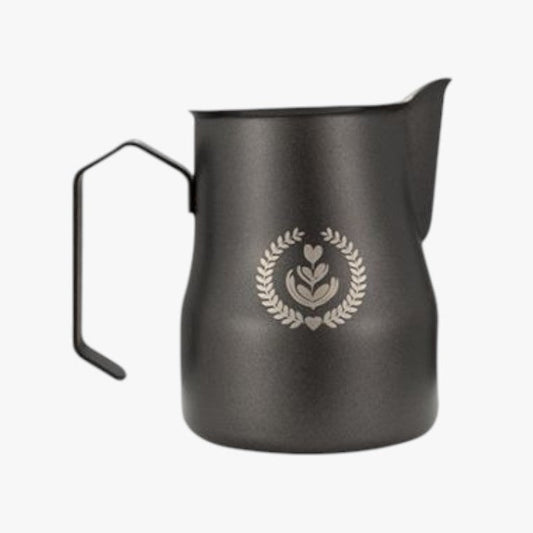
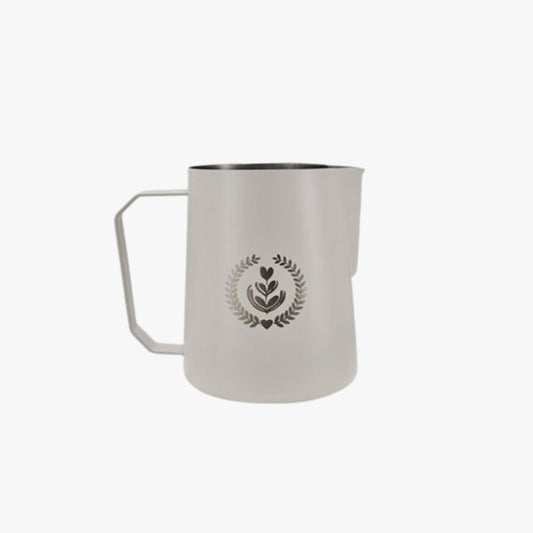
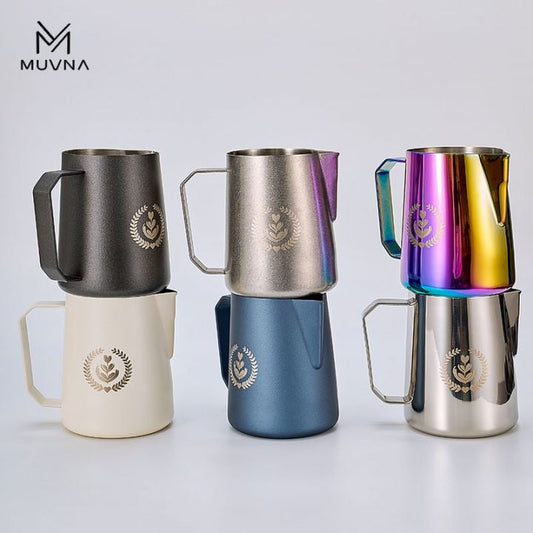
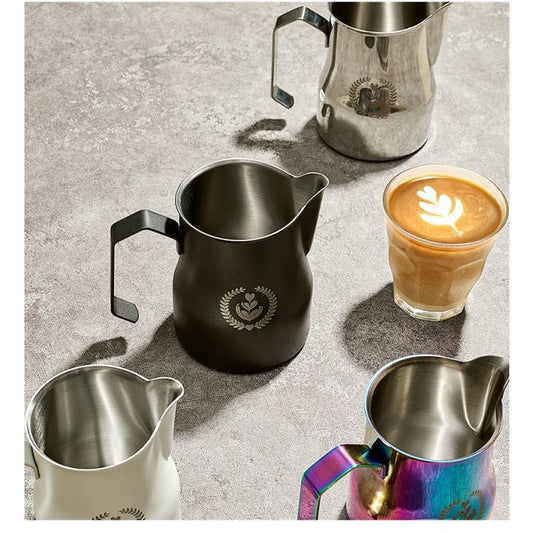
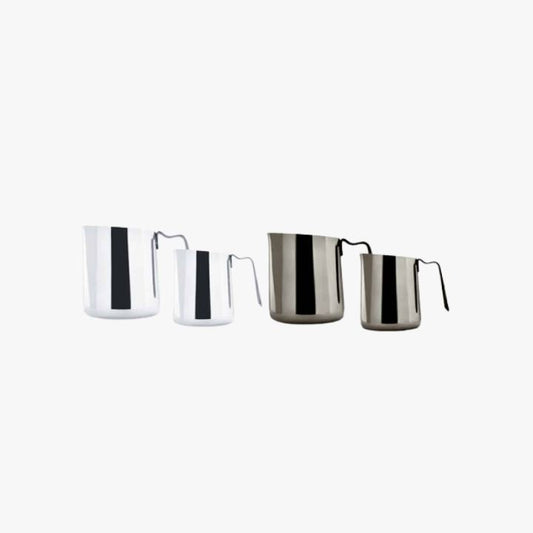
A milk pitcher may seem simple, but your choice makes a difference to your milk foam and latte art. Two questions can help you choose: how much milk do you froth, and how far along are you with latte art?
Question 1: how much milk do you froth?
You only fill a milk pitcher one-third to halfway. The milk needs room to expand and swirl. A pitcher that’s much too large for the amount of milk you’re using won’t work well either: the steam wand won’t stay below the surface, and the foam will be uneven.
- About 350 ml (12 oz): for one cappuccino, flat white, or latte.
- About 600 ml (20 oz): for a large latte or two cups at once.
Question 2: how far along are you with latte art?
- Beginner: a round spout is more forgiving. It pours a wider line and works well for hearts and simple patterns.
- Advanced: a pointed spout gives you more control. You can pour thinner lines and create more details.
Choose your material
Stainless steel is the standard. It conducts heat predictably, so you can feel the pitcher warming up and know when the milk is warm enough. That’s especially helpful when you’re just starting out. A coating can dull that feeling.
How to choose
| Beginner | Advanced | |
|---|---|---|
| One cup | Approx. 350 ml, round spout | Approx. 350 ml, pointed spout |
| Two cups or one large latte | Approx. 600 ml, round spout | Approx. 600 ml, pointed spout |
In our collection
- MUVNA Latte Pitcher 350 ml: stainless steel with a precision spout for latte art.
- MUVNA Latte Pitcher 450 ml: suitable for 1 to 2 cappuccinos.
- MUVNA Latte Pitcher 600 ml: polished stainless steel with a sharp spout.
- MUVNA Italian Milk Pitcher 350 ml: with an ergonomic handle and stable base.
- Silver Rhino Pro milk pitcher 360 ml: stainless steel with a thick 1 mm wall.
View all milk pitchers.
What can you do with it?
- Learn to froth milk using stretching and rolling.
- Pour your first latte art heart.